
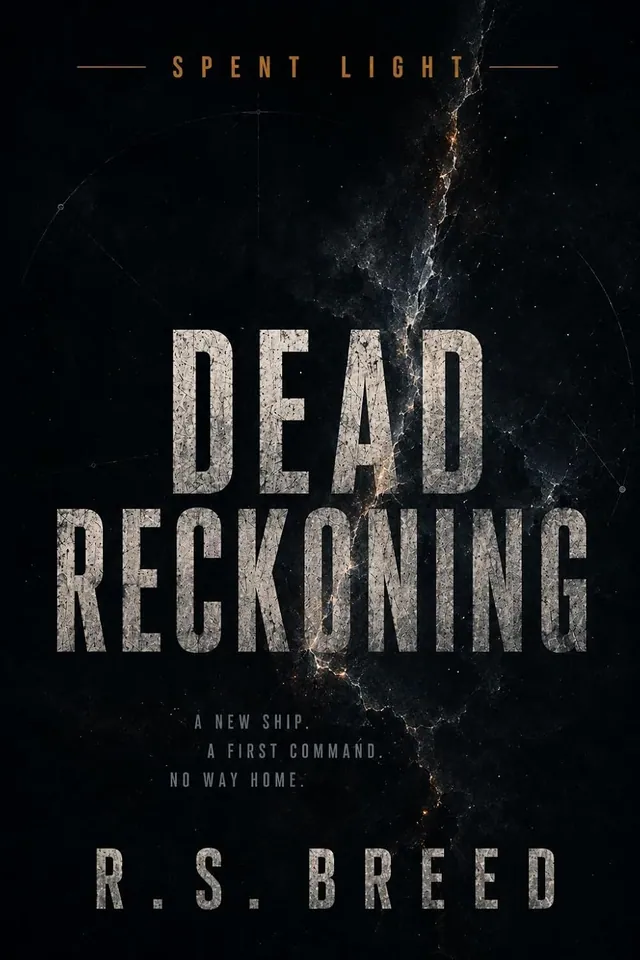
Dead Reckoning
by R. S. Breed
A new command ship, a celebratory maiden voyage, and everything that can go wrong past the edge of the map.
The ISV Endurance is the newest ship in the fleet, on a maiden voyage meant as a celebration. In mid-fold it goes wrong. She loses her captain to sabotage and every link to home in the same hour — no relay, no charted lane, no line back. Command falls by emergency authority to a Geneva diplomat who has never run a ship, while the one officer who could hold the deck is the one nobody picked.
Cut off, outnumbered, and bleeding systems she can't replace, the Endurance has to find her own way back the oldest way there is — by dead reckoning, trusting nothing but her own logged track and the nerve of a crew that isn't yet a crew. Every choice costs something that doesn't come back.
Era
2240
Series
Book One of Spent Light
Price
$0.99
Audiobook: US$4.99
Read it
Kindle On AmazonListen free
The whole book, narrated, free. On the podcast apps it runs one chapter per episode.
Own the audiobook
Buy directUS$4.99 Instant download Kobo Plus Included with Kobo Plus KoboUS$4.99 On Kobo Google PlayUS$4.99 On Google PlayUnabridged, narrated with a synthesised voice. Buy direct is an instant download: DRM-free MP3s, one per chapter.
Finished it? Talk about Dead Reckoning on the forum →
New to R. S. Breed? Dead Reckoning is a good place to start. It tells its own story and opens Spent Light, a finished trilogy best read in order, and its people carry on into the wider Fracture Cosmology.
If you came for command under pressure
The most driven door into the universe, with real set pieces: a fleet engagement you watch from inside a dying hull, breach-suited boarding actions in the dark, and a ship that has to cannibalise itself to keep moving. Command passes to people who never expected it, and not every reader will like how they carry it at first.
If you came for the hard SF
Navigation done honestly — a blind ship reckoning its position from its own logged motion, error growing in the count, no magic fix. A cost ledger where spent systems stay spent. And, underneath, the first deep look at a universe a dozen novels are quietly building toward.
Who you’ll meet
Artefacts from this book
The archive →In-universe records, blueprints, and documents drawn from Dead Reckoning — the institutional paper trail behind the story.
Anchorage Patchwork Hull — Reconstruction
An ISCA-TI intelligence reconstruction of an Anchorage clandestine-fleet vessel, built from fragments — no class, no registry, no two alike. A hull cut from donor ships and welded into a biography of the ships it was scavenged from.
ISV Endurance — Blueprint
Meridian-class deep explorer, EX-01. Modular hull mated at structural collars. The collars that make her quick to refit are the ones an act of sabotage will exploit.
ISV Endurance — Bridge Log
The autologged bridge record of the fold that should have been routine. Commit, anomaly, cold collapse — then NO CARRIER, and a nav mode no one trains for any more.
ISV Endurance — Damage Control Assessment
D. Ferris
Aft third sheared at the collars. Fifty-eight dead. One drive commit remaining. The ledger of a ship that has to keep flying anyway.
ISV Endurance — Salvage & Refit Inventory
D. Ferris
The quartermaster's ledger of a proud new ship becoming a patchwork that works — scavenged hull-alloy, alien feedstock welded to the frames, a magazine spent to zero and re-sleeved with enemy rounds.
Julian Mercer — Private Journal
J. Mercer
A handful of entries from the slate of a man who has only ever run a room, now running a ship with no way home. Never filed.
Meridian-Class Orbital Shipyard — Construction Schematic
How a kilometre-class deep explorer comes to be: a Meridian hull in its orbital assembly cradle, dwarfing the tugs that build her. Section-mated, collar-joined, and never once on a planet. The scale of the Endurance, drawn honestly.
Meridian-Program Support Craft — General Arrangement
The three craft an explorer reaches a surface by, drawn to one scale: the DS-7C dropship (the work truck), the LN-5B lander (science, and the finite surface fleet), and the YT-4A yard-tender (salvage and tow). A Meridian never lands herself — these do.
The Orun — First-Contact Reconstruction
A contact-intelligence reconstruction of the silent power that holds the deep field: armoured non-geometric masses, vibration-and-EM speech the translator cannot read, and a single anomaly the assessment will not resolve — the behaviour reads defensive, not territorial.
The Anchorage — Threat Assessment (2218)
ISCA-TI · Movements Desk
The institution's first standing assessment of the Anchorage. Read it for what an intelligence service sounds like when it has decided, in advance, that the thing it is looking at cannot hurt it. Every confident sentence here was wrong by a different route.
The Anchorage — Threat Assessment (2235)
ISCA-TI · Movements Desk
Seventeen years on, the same desk corrects itself. It was right that the Anchorage will not harm a person, and it revised everything else. What it could not do — what it did not do — was notice that those two facts do not protect anyone.
Distribution Memo — Assessment 2235 (Awareness Only)
ISCA-TI · Registry
The most honest document in the archive, because it is the one that did the least. A one-page slip recording who received the Anchorage assessment, what they were asked to do about it — nothing — and who, five years later, went looking for it.
To Save the Earth, Save the Universe
Stave Press · Bergen
A recruitment broadside of the mainline Anchorage — the reformers, not the cells. Pressed by hand in Bergen and left on benches and bar tops across the northern ports. It argues, in the movement's own plain creed, that you cannot wall a single world off from a wound in the whole of things.
No More Tolerances
Attribution — Anchorage splinter cell
A handbill of a different hand entirely — pulled from a locker at the repair yards, attribution assessed to one of the Anchorage's breakaway cells. The mainline movement prints in the open and disavows this. The cells print in the dark. The institution, characteristically, struggles to tell the two apart.